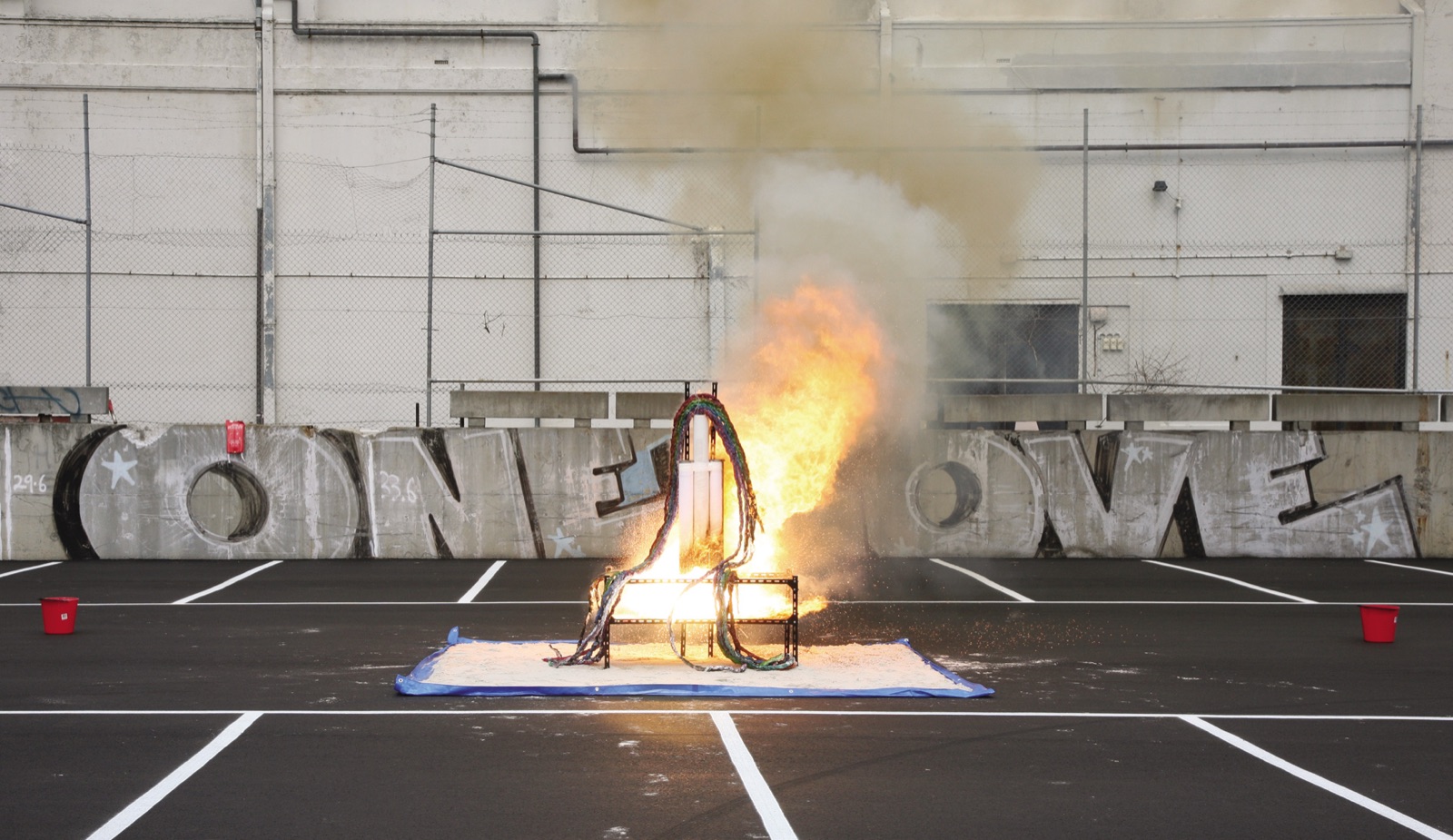
Permanent Rainbow R-C Helicopter Version
McKay’s practice draws in complex ways on conceptualism, performance art, video art and relational aesthetics. Yet despite this complexity, it works on the viewer in an uncommonly direct way. It does so, at least in part, because it exploits a visual vocabulary that we understand implicitly and at an emotional level. His rainbow, for instance, calls for no special knowledge on the part of the viewer. It won’t especially help one’s understanding of the work to be told about, say, the optics that gives rise to rainbows (did you know they always appear opposite the sun?), their significance in religion and myth (in Norse mythology the rainbow is Bifrost, a bridge to the land of the Gods; at the end of the world it will come crashing down), their presence in art and poetry (Keats complained that science would “unweave a rainbow”), and so on.
Nor does McKay’s rainbow rely on familiarity with its actual appearance after a rain shower. After all, who spends much time looking at that? No—his rainbow is of a kind we are all more intimately familiar with. I mean the rainbow as it is found from the nursery onwards in our culture: not a soft luminous arc across the sky, but an object—the sturdy arch of five, six or seven coloured bands whose warp and woof accord, roughly, with the primary school mnemonic Roy G. Biv. This rainbow has a life as a symbol and decorative motif throughout our culture. Putting aside its adaptation by the GLBT community in the rainbow flag, this life is a fairly diffuse and degraded one, ranging from children’s toys and clothing to contemporary advertising that hopes to prompt some association with hippie ideals. The symbolic meaning of this rainbow is not something that’s written down anywhere, but I think we each have a feeling of what it is: something like freedom, self-realisation, inclusion and community. The failure figured by the crashed rainbow needs little explanation either. It makes sense both at a physical level—after all, it looks more like it belongs in some bedraggled shop-front display than in the sky—and at a symbolic level, for we feel that those ideals of self-realisation, inclusion and so on won’t fly so easily in this cynical age.
Still, while the realisation of those ideals may of necessity be very imperfect, striving towards them in the face of an implacable world is a kind of testament to their abiding presence within us. Perhaps this is the point of McKay’s work. “Two things,” said Kant, “fill the mind with ever new and increasing wonder and awe”. One is “the starry heavens above”, to which we might also add other phenomena of the natural world, such as rainbows. The other is “the moral law within”, with which we might also group those ideals of which I’ve spoken. If the first kind of wonder is in short supply in the contemporary world, McKay’s sad, hopeful work suggests that we might not be lacking in the second kind.
Essay
Michael Newall, Canterbury, UK, 2019